π Ulsan, South Korea
International Journal of Computer Vision (IJCV), 2025
Gyeongsu Cho, Changwoo Kang, Donghyeon Soon, Kyungdon Joo
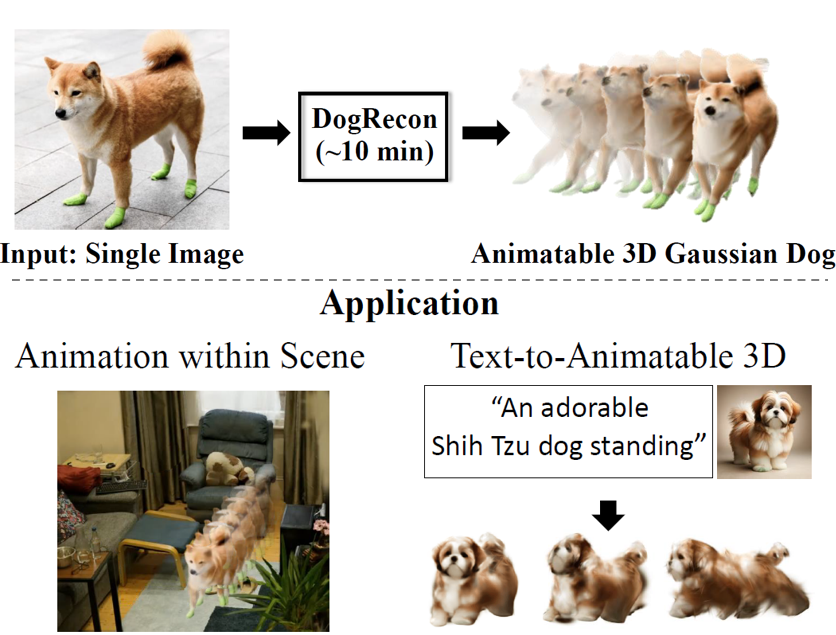
Our insight is to combine the acquisition of appearance from generative models, without additional data, with geometric guidance provided by a parametric representation, aiming to achieve complete geometry. Thus, we present DogRecon, our framework consists of two key components: Canine-centric novel view synthesis with canine prior for multi-view generation of dog and a reliable sampling weight strategy with Gaussian Splatting for animatable 3D dog reconstruction.
AAAI Conference on Artificial Intelligence (AAAI), 2024
Dongjun Gu, Jaehyeok Shim, Jaehoon Jang, Changwoo Kang, Kyungdon Joo
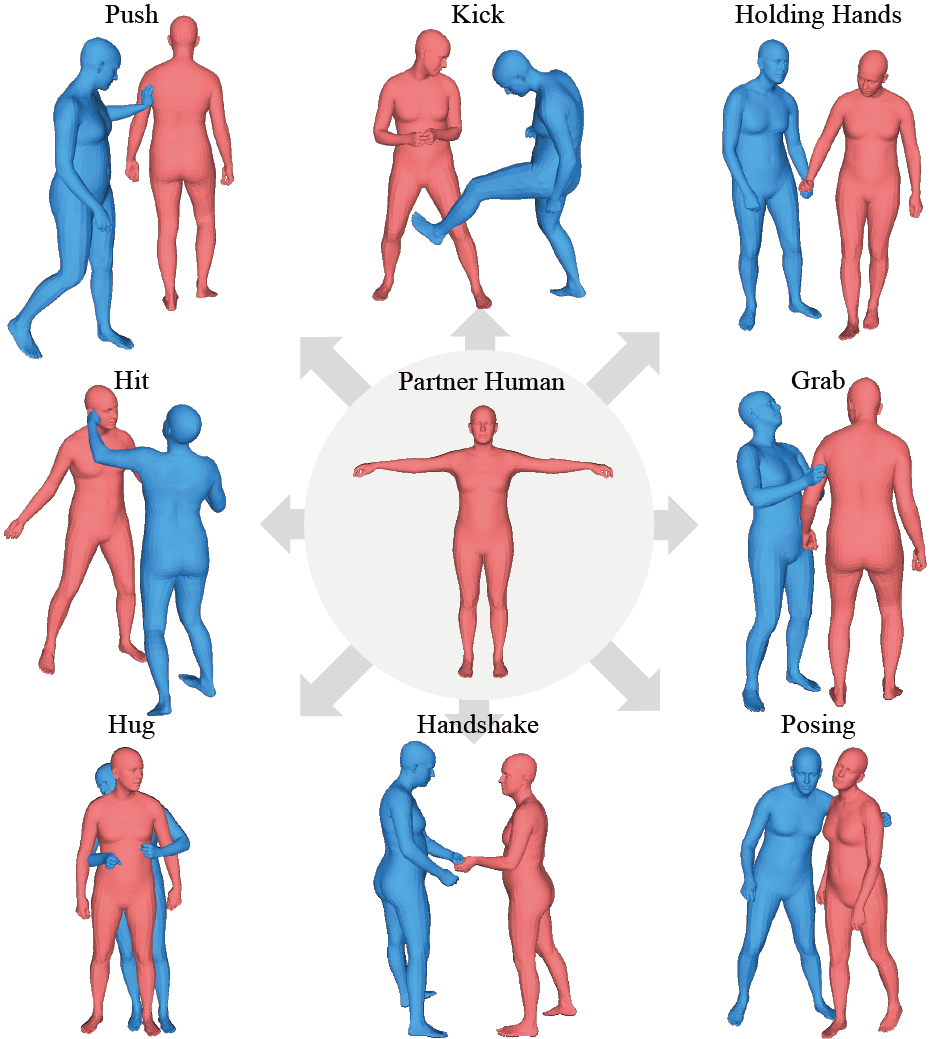
We propose a novel method of generating interactive 3D humans for a given partner human based on a guided diffusion framework (ContactGen in short). Specifically, we newly present a contact prediction module that adaptively estimates potential contact regions between two input humans according to the interaction label. Using the estimated potential contact regions as complementary guidances, we dynamically enforce ContactGen to generate interactive 3D humans for a given partner human within a guided diffusion model.
IEEE/CVF Conference on Computer Vision and Pattern Recognition (CVPR), 2023
Jaehyeok Shim, Changwoo Kang, Kyungdon Joo
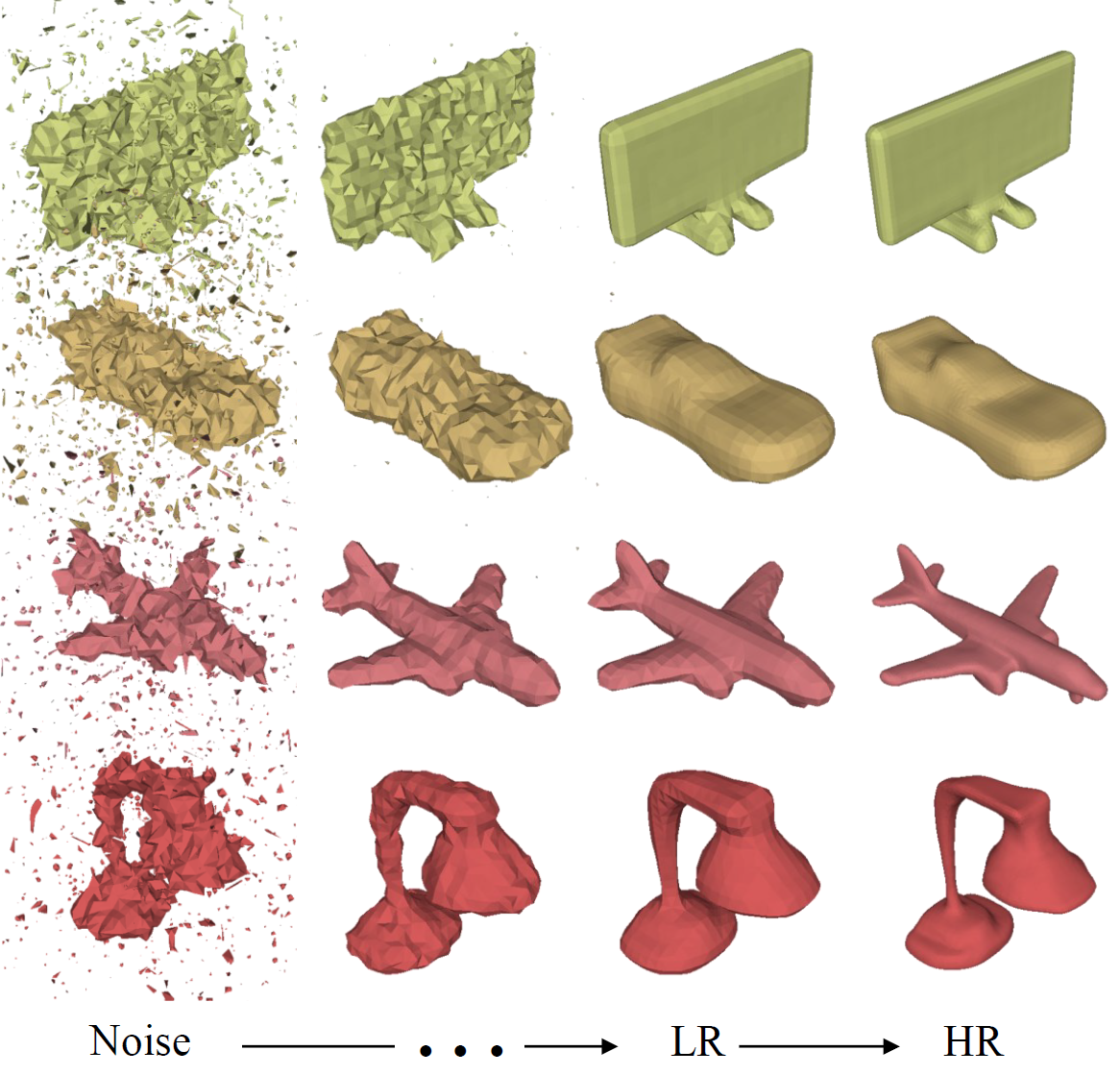
Our framework generates high-resolution 3D shapes while alleviating memory issues by separating the generative process into two-stage: generation and super-resolution. In the first stage, a diffusion-based generative model generates a low-resolution SDF of 3D shapes. Using the estimated low-resolution SDF as a condition, patch-based diffusion model performs super-resolution in the second stage. the later diffusion model disturbs high-resolution noise to synthesis complete shape.
AAAI Conference on Artificial Intelligence (AAAI), 2023
Minseok Kim, Changwoo Kang, Jeongin Park, Kyungdon Joo
We present a new 3D human generation framework that considers geometric alignment on potential contact areas between 3D human avatars and their surroundings. In addition, we introduce a compact yet effective human pose classifier that classifies the human pose and provides potential contact areas of the 3D human avatar. It allows us to adaptively use geometric alignment loss according to the classified human pose.